Birthplace as a heritage and community attraction
The Blantyre Town Centre Strategy records that the David Livingstone Centre reopened in July 2021 after a reported £9.1 million regeneration. Its account describes new exhibition space in the historic Shuttle Row tenements, a refurbished shop and café, a children’s play area and 11 hectares of free-to-access parkland. This is useful dated evidence of the birthplace’s contemporary museum and greenspace role as well as its biographical importance; it does not replace architectural records for the building phases or establish the full current operating offer. The strategy identifies the centre as a significant visitor attraction within walking distance of the town centre and as a contributor to the local visitor economy. South Lanarkshire Council, Blantyre Town Centre Strategy, p. 4 (South Lanarkshire Council: Blantyre Town Centre Strategy and Action Plan) Blantyre Town Centre Strategy Bothwell, Blantyre and Uddingston Local Nature Reserve
Family and mill village
The Livingstone family came from the island of Ulva to seek employment in the Clyde cotton industry. David was born on 19 March 1813 in Shuttle Row, a workers’ tenement associated with the Blantyre Cotton Works and Works Village. The museum identifies the family’s accommodation as a single-end: a one-room domestic space within the mill village. Its interpretation says Shuttle Row housed 24 families in total. The National Lottery Heritage Fund’s account also places his birth in the factory accommodation. These are institutional accounts of the site and family connection; fuller household reconstruction would require parish registers, census schedules and contemporary records. Birthplace museum · National Lottery Heritage Fund
Child labour and study
The museum timeline dates Livingstone’s entry into mill work as a piecer to 1823, when he was ten. The museum describes piecing as joining broken threads at moving spinning machinery and gives the working day as 6 a.m. to 8 p.m.; its life account says he attended evening school after work and continued reading. A newly prepared museum learning resource calls the work dangerous and explains the physical task. These details illuminate the childhood labour system in which the town’s textile economy depended on children as well as adult workers. Exact hours and conditions should be understood as the museum’s account and compared with factory legislation and inspection evidence before generalising to every worker. Museum timeline · Museum life account · Learning resource
The museum says that at nineteen Livingstone became a spinner and used his earnings for tuition at the Andersonian Institute in Glasgow. University of Glasgow Archives adds that he also attended Greek classes at the University and divinity classes taught by Congregationalist minister Ralph Wardlaw. Its collection note places these studies in the context of his ambition to become a medical missionary, initially for China. These studies connected an industrial wage to professional education; they should not be simplified into an effortless or purely self-taught rise. Museum timeline · University of Glasgow Archives and Special Collections
Departure and return
The museum dates medical training in Glasgow to 1836, acceptance by the London Missionary Society to 1838 and arrival in southern Africa to 15 March 1841. The University of Glasgow account likewise records his 1841 appointment and says his mission combined Christian aims with opposition to slavery. These short institutional chronologies provide orientation but do not replace his journals, medical records, missionary correspondence or scholarship on African societies and the effects of European exploration. Birthplace timeline · University of Glasgow
Livingstone returned to Blantyre on 31 December 1856 at the invitation of the Works’ Literary and Scientific Institute. The museum says he spoke in the schoolroom where he had studied and discussed connections between Blantyre cotton and African trade, including cotton produced through enslaved labour. His visit joined local industrial identity to the global supply chains behind cotton manufacture.
Legacy and local memory
Shuttle Row became a memorial and museum site, preserving a material link between a globally prominent life and the mill workers’ settlement. That memorial history has its own chronology and should not be treated as proof that every detail of the claimed birthroom was uncontested: local-history research records debate in the early twentieth century over the precise room and the claim. The museum’s current interpretation identifies Shuttle Row as his birthplace, while the details of the memorial campaign and its historical disputes merit a separate evidence-led account. The setting connects this biography to Low Blantyre and the Works village, the cotton village, and Blantyre population, 1755–1951, which records the parish’s demographic change.
Visual records of Shuttle Row
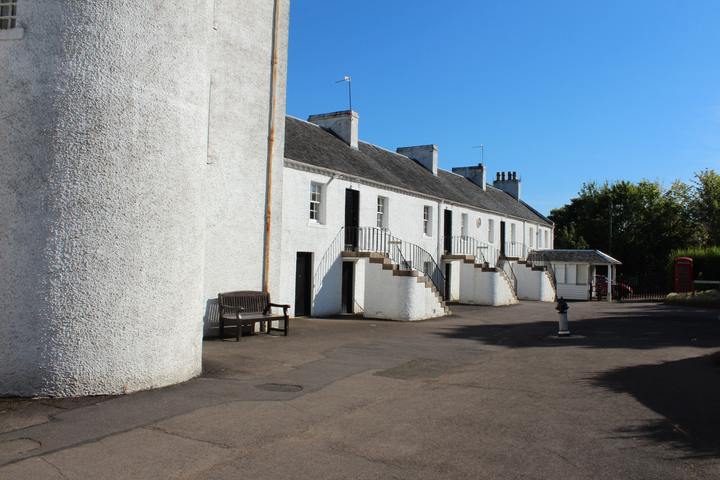
A geolocated photograph by Billy McCrorie records the exterior of Shuttle Row at the David Livingstone Centre. The locally verified image is shown below; its present-day museum setting should not be mistaken for an unchanged view of Livingstone’s childhood. commons shuttle row billy mccrorie 4679880
Photographic records of Shuttle Row
A set of Church of Scotland mission lantern slides catalogued through the Centre for the Study of World Christianity includes images identified as Shuttle Row and as the room understood to be David Livingstone’s birthplace. The archive’s coverage date is broad, circa 1875–1940, so these are later visual records of the buildings and room rather than contemporary images of Livingstone’s childhood. The room caption describes a box bed, fireplace, chairs and cupboard; those details should not be projected back to 1813 without independent evidence.
Shuttle Row today

Related
- Blantyre Cotton Works and Works Village
- david livingstone birthplace cotton works
- david livingstone birthplace timeline
- national lottery heritage fund livingstone birthplace
- university of glasgow livingstone archives
- david livingstone birthplace life
- david livingstone birthplace learning resource