The colliery before the explosion
The report text reproduced by the Coal Mining History Resource Centre (CMHRC) describes a rapidly expanding coalfield around Hamilton. It says Blantyre Colliery had begun operations about six years earlier, had raised around 880,000 tons, and then employed about 500 people across its pits. Nos. 1–4 were working or being developed at differing depths and in the Ell, Main and Splint seams; No. 5 was an upcast shaft. Nos. 2 and 3 worked the Splint Coal and were directly connected underground, while No. 1 workings connected to No. 2 through blind pits. No. 4 was not yet connected to the other workings. This is a transcription of a report, not a surveyed colliery plan; technical layout statements below are attributed to the report rather than presented as modern surveyed measurements. CMHRC compiled transcription, pp. 20–21 · NMRS disaster dossier · Blantyre Colliery
The inquiry material portrays a large, complex mine in which ventilation depended on a network of connections and furnace-driven upcast. The No. 5 shaft served Nos. 1, 2 and 3; furnaces drew air through multiple working sections. The workings extended for several miles among old stoops, and inspectors discussed the condition and ventilation of older pillars as well as active faces. The colliery was known to produce firedamp, including sudden outbursts. The report’s criticism was not simply that ventilation machinery was absent: it concerned how air was split and routed, the length of the routes to working places, connections between pits, and whether abandoned or old workings were examined and recorded. CMHRC transcription, pp. 20–21, 42–44
A warning accident two months earlier
A separate firedamp explosion occurred in No. 2 Pit on 20 August 1877. In a Commons exchange in May 1878, Alexander Macdonald quoted Inspector Ralph Moore’s report: a roof fall in waste had released firedamp which ignited at the two workers’ naked lights. The Lord Advocate confirmed that one man died and one was injured, and said Moore had relied on accounts from men who professed to witness the event rather than visiting the injured boy, named in the question as Francis McMulty. The exchange also clarified that no prosecution order had been made against fireman Black; the Procurator Fiscal’s investigation was unfinished when Black died in the October disaster. This parliamentary record supplies a more secure outline than the conflicting names and outcomes in later local transcriptions, but Moore’s report and the legal file remain necessary for the men’s identities, evidence and responsibility. It is a distinct incident, not proof of the October explosion’s cause. Hansard, 16 May 1878 · Blantyre Colliery · hansard blantyre august accident 1878
The explosion and rescue
The explosion occurred at about nine o’clock in the morning. The reproduced inspectors’ account says flame and steam rushed up No. 3 shaft for between one and four minutes, smoke emerged from the upcast shaft, and there was a rush of air from No. 2. The blast was felt in No. 1, where miners began to ascend. A local newspaper report dated 27 October, reproduced in a later educational source pack, described a great flash, coal dust darkening the air and families hurrying from the nearby rows towards the pits. Its estimate that nearly 240 men and boys had descended was an early report, not a final count. A separate mining trade journal published on 27 October printed a Glasgow dispatch received on 23 October that estimated 233 men had descended and said all but four were then believed lost; the shaft and rescue account shows how incomplete that information still was. Nuffield Primary History source pack, pp. 3–4 · Engineering and Mining Journal, 27 October 1877, p. 310 · CMHRC compiled transcription
The blast damaged shafts, stoppings, roadways and equipment across connected workings. Testimony describes the tramroad, hutches and bratticing being broken apart, with traces extending through much of the mine. Some miners escaped from the north side of No. 2; the transcription lists men who came out alive, bodies recovered at both pits, and people rescued alive who subsequently died. These accounts describe a prolonged rescue and recovery under dangerous underground conditions, but their lists are incomplete and sometimes visibly corrupted by transcription or OCR. Names should not be normalised from this text alone. CMHRC transcription, pp. 21–24 · NMRS disaster dossier
Inquiry and safety findings
The Home Secretary appointed Robert MacLean, an advocate, and Joseph Dickinson, a Mines Inspector, as commissioners. In the reproduced introduction, Dickinson says he inspected accessible parts of the workings on 27 October, five days after the explosion, to record blast traces before they were obliterated. The public inquiry opened at County Hall, Hamilton, on 12 November and ran for eleven days, ending on 23 November. The compiled transcript says 48 witnesses gave evidence. A later local transcription presents the report as dated 21 December 1877, while the report excerpt reproduced elsewhere carries a Rutherglen dateline of 22 November; the apparent discrepancy may reflect separate reports or transcription errors and needs comparison with the printed papers. CMHRC transcription, pp. 42–44 · Blantyre Project, report extract
The inquiry testimony describes pillar-and-stall working, open oil lamps as routine, and safety lamps used selectively around faults, known gas or stoppings. It says blasting was prohibited in some workings but occurred in others; the evidence also addresses the carrying and use of powder, firemen’s inspections, gas-report books and the absence of consistent records for old workings. These are reported practices and contested testimony, not proof that every worker or section operated in the same way. CMHRC transcription, pp. 20–21, 42–44 · NMRS disaster dossier
The inspectors could not give a definite opinion about the source of the large quantity of gas or the exact point of ignition. They leaned towards gas lodged in old pillars, probably between Spier’s Dook and the connection from Nos. 2 and 3, meeting an open light. Their recommendations included locked Davy lamps, better ventilation of pillars, prohibition of shot firing, stricter discipline, more judiciously separated air currents, more concentrated working and more frequent throughers to shorten the distance air travelled behind bratticing. This was a reasoned but explicitly uncertain conclusion: it did not identify a single proven ignition event. This account follows the surviving inquiry transcription and does not claim an independently verified cause. CMHRC transcription, pp. 42–44 · Blantyre Project inquiry summary
A secondary transcription of the report says the commissioners did not consider a statutory penalty appropriate in the circumstances, despite describing lax discipline and practices that raised safety concerns. The distinction between criticism of the system and an individual legal finding matters: the cited account does not establish criminal liability.
Disputed death totals and counting practices
Published and transcribed totals include 207, 209, 211, 212, 215, 218 or more, and 220. South Lanarkshire Council and some later summaries use 207; the Northern Mine Research Society gives 211 in its introductory summary but 209 in the detailed account; the 1879 NLS directory gives 212; later victim research reported by Blantyre Project says the total reached 215; the parish-priest account gives 218 or more; and the c.1885 Ordnance Gazetteer gives 220. The NMRS page is internally inconsistent on this point. An early local newspaper account estimated nearly 240 had gone down the pit; that is an estimate of those who descended, not a death toll. The cited sources do not consistently state the date or category used for each total, so no single explanation for their differences is established. These remain attributed reports rather than one reconciled nominative total. South Lanarkshire Council · NMRS · NLS directory, 1879 · NLS, Ordnance Gazetteer · Nuffield source pack
The CMHRC transcription itself preserves more than one accounting statement. One passage calls the loss 209 and gives 103 bodies from No. 3, two later hospital deaths, 100 from No. 2, a later infirmary death, and two missing men subsequently recovered dead. Another passage attributes to the Procurator Fiscal a tally of 101 deaths in No. 2 and 106 in No. 3—207 known deaths—plus two missing. The text does not explain how those statements relate, and the apparent totals do not reconcile arithmetically without assumptions. They therefore remain separately attributed rather than compressed into one “official” figure. CMHRC transcription, p. 42
The Reverend Stewart Wright’s parish history, excerpted in the Nuffield resource, says 218 or more men and boys were killed and records 106 widows and 300 fatherless children, as well as dependent relatives. These figures document a local cleric’s account of the community’s loss and its immediate social burden; they do not constitute a verified death register. A later diocesan account remembers the event as “some 230” dead and about half Catholic. Such figures also belong to histories of remembrance and should be labelled accordingly. Nuffield Primary History source pack, p. 2 · Diocese of Motherwell, St Joseph’s history
The 1879 NLS directory states that 233 men and boys were at work, 27 escaped and four brought out alive later died; it gives 212 deaths and reports nearly £50,000 subscribed for widows and children. These details are not easy to reconcile with its own wording, other headcounts, or later totals. They remain useful evidence for how the disaster and relief were reported two years later, not a final civil-registration count. The copyrighted later victim list has not been reproduced here. The printed report, individual death registrations, burial registers, inspector records and contemporary newspaper issues are required to establish each number’s scope and the identities behind it.
Families, housing and community impact
The local newspaper excerpt depicts relatives leaving rows close to the colliery and rushing to the pithead. Wright’s account describes widows, children and dependent relatives left by the disaster. A Scottish Archaeological Research Framework case study interprets tied housing as a mechanism of employer control and states that 34 widows were evicted within six months; a local-history account attributes the subsequent action against widows in colliery cottages to newspaper reports and Sheriff Court proceedings in 1878. The framework page does not cite the underlying records. The reported figure is also repeated in a local-history account of the 1878 Sheriff Court proceedings, but the original court process, newspaper report, company housing records and affected household list remain uninspected. The reported evictions should be understood in the context of tied accommodation, where a miner’s death could remove both household income and the family’s claim to a company dwelling. Nuffield source pack · ScARF, miners’ rows case study · Blantyre Project, widows’ ejection · Miners’ housing and rows in Blantyre
A local-history page also supplies a red-dot map purporting to locate fatalities by address within a subset of Dixon’s Rows, and a separate page reproduces diagrams of the underground workings at Dixon Nos. 2 and 3 for 1877. These are valuable prompts for spatial research, but the site identifies the diagrams as reduced reproductions from Matt O’Neill’s book and explicitly restricts copying; the map’s source list and plotting method have not been verified. The casualty article therefore uses the reported spatial pattern only as an attributed lead, not as a new count or independently proven distribution. blantyre project 1877 fatalities map blantyre project dixons underground mine maps Fatality-map source page · mine-map source page
The explosion also became part of national debate over mining safety. In May 1878, after another firedamp accident at Eddlewood near Hamilton, Alexander Macdonald asked whether naked lights would be restricted across the coalfield. The Home Secretary referred to a warning in the Blantyre inquiry and said he had instructed the inspector to convene mine owners and draw attention to it. In August, during debate following the Haydock explosion, MPs invoked Blantyre while arguing about inspection, ventilation and management responsibility. These parliamentary exchanges document policy concerns and official responses; political allegations are not substitutes for inquiry findings or court verdicts. Hansard, 17 May 1878 · Hansard, 8 August 1878
Images, memory and later accidents
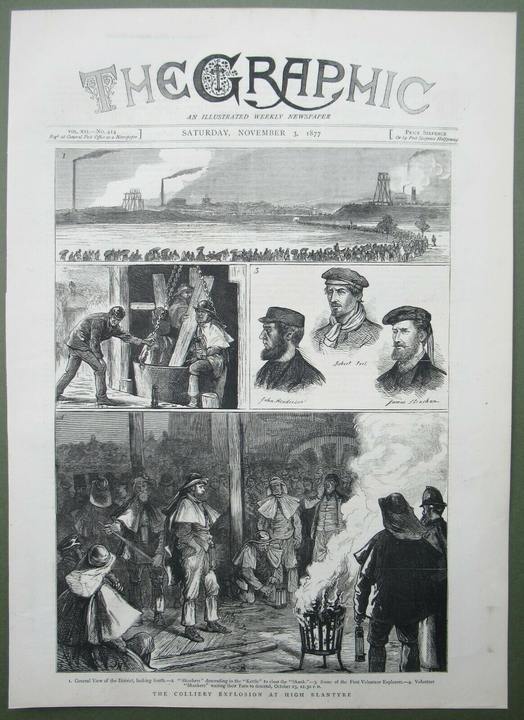
A page in The Graphic, dated 3 November 1877, combines a general view of the district with rescue scenes and portraits. Its printed captions describe “shankers” descending into the shaft and volunteer explorers waiting at the entrance on 23 October. The Commons record attributes the illustration to the journal’s staff and marks the two-dimensional work and faithful scan public domain. This is the illustrated press’s contemporary account, not a photograph or a measured record of the rescue.

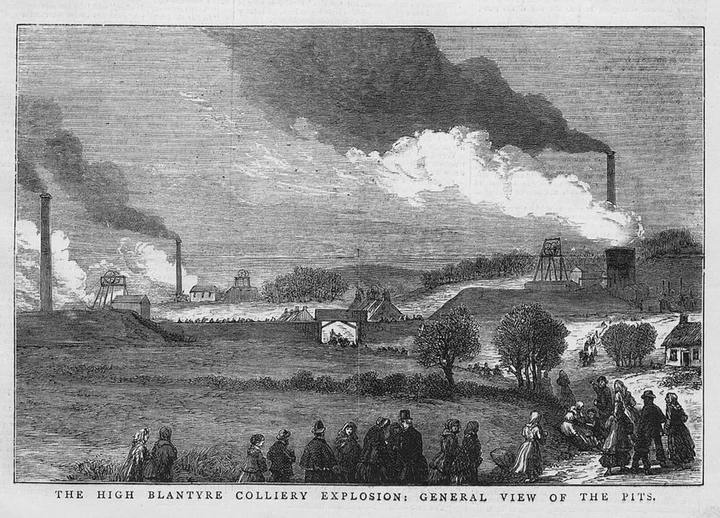
A separate engraving in The Pictorial World bears the title “The High Blantyre Colliery Explosion: General View of the Pits”. It presents the pits as a landscape; it is a second contemporary press representation, not a surveyed mine plan.

The explosion was followed by other fatal incidents at the same colliery group, including the March 1878 overwinding accident and July 1879 explosion. These were separate events in different pits, with distinct mechanisms and evidence. The earlier March 1874 Priestfield explosion and an August 1877 No. 2 Pit firedamp incident also show that the October catastrophe occurred amid a record of varied mining hazards, but do not prove that the earlier incidents shared its cause. Blantyre Colliery overwinding accident of 1878 · Blantyre Colliery explosion of 1879 · Blantyre Colliery
Commemoration
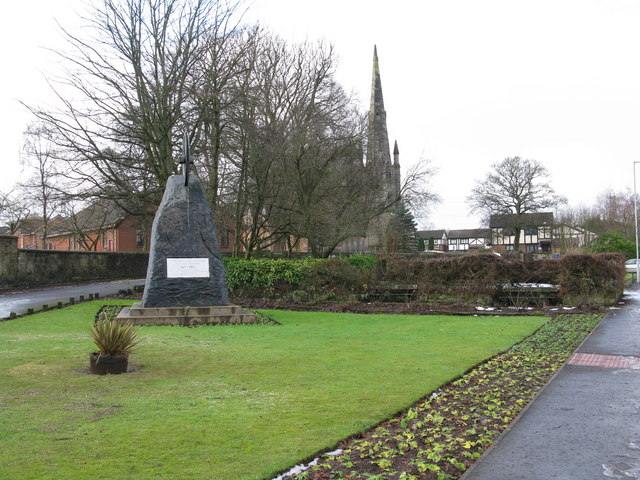
Broader mining landscape
Local histories describe the 1877 explosion within a parish where multiple colliery companies and dispersed rows were already expanding; they also report conflicting 1891 workforce totals that are kept separate from disaster casualty numbers. blantyre project coal mining Blantyre Colliery
Related
- Blantyre Colliery
- northern mine research society blantyre disaster
- blantyre project 1877 inquiry summary
- Blantyre Colliery explosion of 1879
- Blantyre Colliery fire of 1880
- blantyre directory 1879
- uk parliament hansard mining debate 1878 08 08
- uk parliament hansard blantyre coalfield 1878 05 17
- cmhrc blantyre 1877 inquiry transcription
- nuffield victorian mining disasters resources
- commons graphic blantyre explosion 1877
- national mining museum family history guide