Establishment and production
James Anderson’s New Statistical Account says a first mill was erected in 1785 by David Dale and James Monteith for spinning water-twist yarn, followed by a second mill in 1791 for mule-twist. Both used water power from the Clyde. In 1813 a weaving factory was built, and Anderson reported 463 looms with expansion then contemplated towards 500–600. He counted 458 workers in the spinning mills, 30,000 spindles and 128 handloom weavers in the parish. The last figure concerns workers beyond the factory system and should not be conflated with the mill payroll. These are a minister’s contemporary statistics, not surviving audited employment returns. New Statistical Account
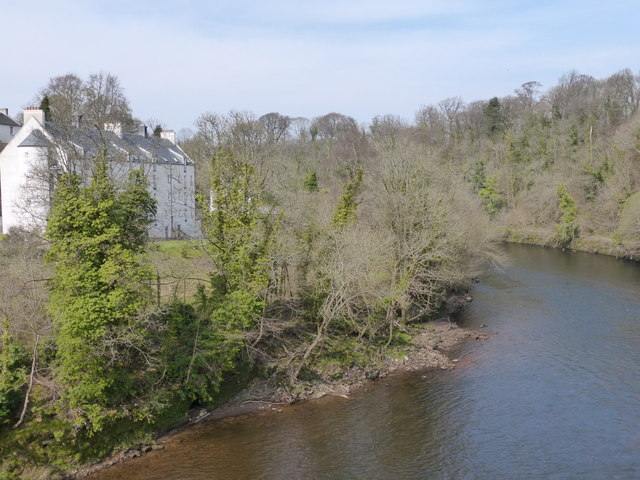
The 1862 handbook calls the cotton-spinning and dye works a foundation of David Dale in 1785 and says they were then owned by Henry Monteith & Co.; it estimates about 1,000 workers across the works. The difference in emphasis between Dale and Monteith is best read as a distinction between foundation, partnership and later ownership until company records establish the exact sequence. The nineteenth-century sources consistently indicate that the enterprise grew beyond the first spinning mill into a larger connected industrial operation. Macpherson, Hand-book (1862) · New Statistical Account
Waterpower and the mapped industrial site
A National Records of Scotland catalogue entry identifies a contemporary 1806–07 plan by Peter Fleming covering the River Clyde from Blantyre Cotton Works upstream to an old mill and dam. Its description lists the works’ buildings, mill lead, tailrace, dam, sluice openings and adjoining owners, together with sections and elevations. At a stated scale of 1:1,100, it is potentially important evidence for how the works harnessed river water and how its water-management structures related to neighbouring land. The catalogue says the plan forms part of the Court of Session records and is viewable through the NRS Search Rooms’ Virtual Volumes or ScotlandsPeople; the catalogue description documents the plan’s stated features and scale, but does not by itself resolve the detailed mill layout or sequence of water engineering. nrs rhp222 blantyre mill plan historical maps NRS catalogue, RHP222/1
Lewis’s 1846 account offers a later employment and welfare snapshot than the c.1835 parish account. It reports 30,000 spindles and about 500 workers in two water-powered spinning mills; 600 power looms driven by water and steam with more than 300 regular workers in the weaving establishment; and nearly 1,000 people across all departments, more than 500 of them women. It also describes Turkey-red yarn dyeing. These categories and approximate totals are the gazetteer’s report, not payroll data, and should not be added as if the two departmental figures were exhaustive or mutually exclusive. Lewis describes company-paid watchmen and cleaners, a public washing-house, a riverside bleach green, domestic water supplied by factory force-pumps, and a workers’ library. Alongside the 1835 account and the 1862 handbook, this suggests a managed company village in which employer-provided infrastructure extended beyond housing, while the precise date and operation of each amenity remain to be established from company records. lewis topographical dictionary blantyre 1846 Lewis, 1846
The NRS catalogue also identifies a second, later engineering record: an 1849 plan of Blantyre Hill Mill dam (RHP222/3), at 1:360. Its catalogue description names the dam, sluice stairs, sluice and mill lead, and says a longitudinal section of the dam-dyke is included. Read together, the 1806–07 river-and-works plan and the 1849 dam plan provide a dated documentary sequence for the water system, but they do not by themselves prove what alterations occurred between the dates. Both drawings remain uninspected, so the actual alignments and engineering changes remain an open research task. nrs rhp222 blantyre hill mill dam historical maps NRS catalogue, RHP222/3
The village and its institutions
Housing for workers grew beside the mill. The museum identifies Shuttle Row as employee accommodation and records that the Livingstone family occupied a single-end there; David Livingstone was born in the row in 1813 and began mill work as a child. His personal story belongs within the wider history of the workforce and should not stand in for the experiences of other employees, including women, children and migrant workers.
The works school, established for millworkers’ children and later used for worship and community gatherings, is treated in detail in Blantyre Works School. The Birthplace Museum dates Livingstone’s address in its schoolroom, after his return at the invitation of the Works Literary and Scientific Institute, to 31 December 1856; this helps distinguish the speech date from a later biography’s claim that Ness issued an invitation in 1857. Birthplace Museum Macpherson’s 1862 handbook describes a company school that was also used for Sabbath worship and a literary association organised among workers. It also notes a company-built suspension bridge across the Clyde. These facilities show how the works’ influence extended beyond production into education, worship, recreation and transport. The bridge’s later history and replacement crossings are treated in Low Blantyre suspension bridge and the Clyde crossings, while education and worship at the works are discussed in Blantyre Works School and Education in Blantyre. Macpherson, Hand-book (1862)
Later Low Blantyre textile listing
Naismith’s 1878–79 directory lists a Dalgleish & Kerr weaving factory in Low Blantyre. It does not state the factory’s products, size, workforce, address within the settlement or relationship to the older cotton works. The entry shows that a weaving establishment was still listed in Low Blantyre in the late 1870s, but it cannot by itself establish continuity with the Monteith mill complex or identify the factory building. naismith 1878 79 industrial directory followup Low Blantyre and the Works village
Surviving mill-village housing
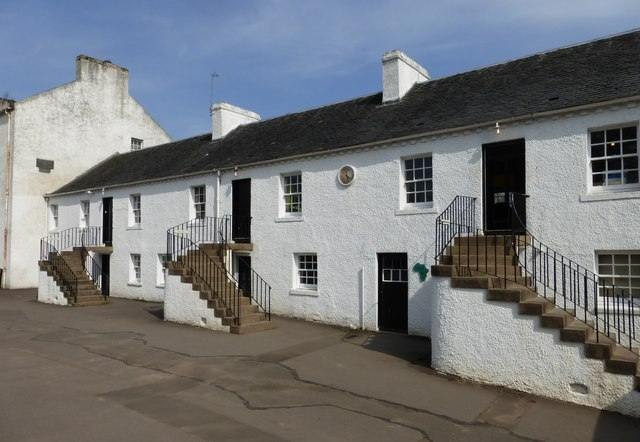
View of the former mill site
Related
- National Records of Scotland RHP222/1: Blantyre mill plan
- Wikimedia Commons: Blantyre Mill Wages Office lantern slide
- Low Blantyre and the Works village
- south lanarkshire council blantyre history
- david livingstone birthplace cotton works
- Blantyre Colliery